
You Are a Statistical Impossibility: Why That Changes Everything
The mind-bending math that proves your existence is the rarest event in the known universe, and what it means for how you live your life.

I want to start with a question that might sound a bit odd.
Do you feel special?
Not in the cheesy, participation-trophy sense. I mean cosmically, mathematically, existentially special.
Because here’s the thing: you should.
The odds of you existing at all (as you, reading this, in this exact moment) are so vanishingly small that calling it a miracle barely scratches the surface.
And once you truly understand how rare you are, it becomes almost impossible not to treat your life differently.
By the end of this article, you’ll learn:
Why the silence of the universe might mean you’re more unique than you ever imagined
The staggering mathematics behind your individual existence
How this cosmic perspective can motivate practical health changes starting today
This will help you appreciate the gift of being alive and take meaningful action to protect it, without needing a PhD in astrophysics or a complete life overhaul.
The great silence
In 1950, physicist Enrico Fermi sat down to lunch with colleagues at Los Alamos National Laboratory.
The conversation turned to extraterrestrial life, and Fermi asked a question that has haunted scientists ever since:
“Where is everybody?”
The math seemed straightforward.
Our galaxy alone contains somewhere between 200 and 400 billion stars.
The observable universe holds roughly 70 sextillion of them (that’s 7 followed by 22 zeros).
Even if intelligent life emerged on just a tiny fraction of planets orbiting those stars, we should have detected something by now.
Radio signals, megastructures, colonization patterns. Something.
And yet? Nothing. Absolute silence.
This contradiction between the apparent probability of alien life and our complete failure to find any evidence of it became known as the Fermi Paradox.
For decades, researchers proposed explanations. Maybe civilizations destroy themselves. Maybe they’re hiding. Maybe they exist in forms we can’t recognize.
But a 2018 analysis from Oxford’s Future of Humanity Institute suggested something more startling.
Researchers Anders Sandberg, Eric Drexler, and Toby Ord re-examined the famous Drake Equation (the standard formula for estimating intelligent civilizations) and found that previous calculations had been deeply flawed.
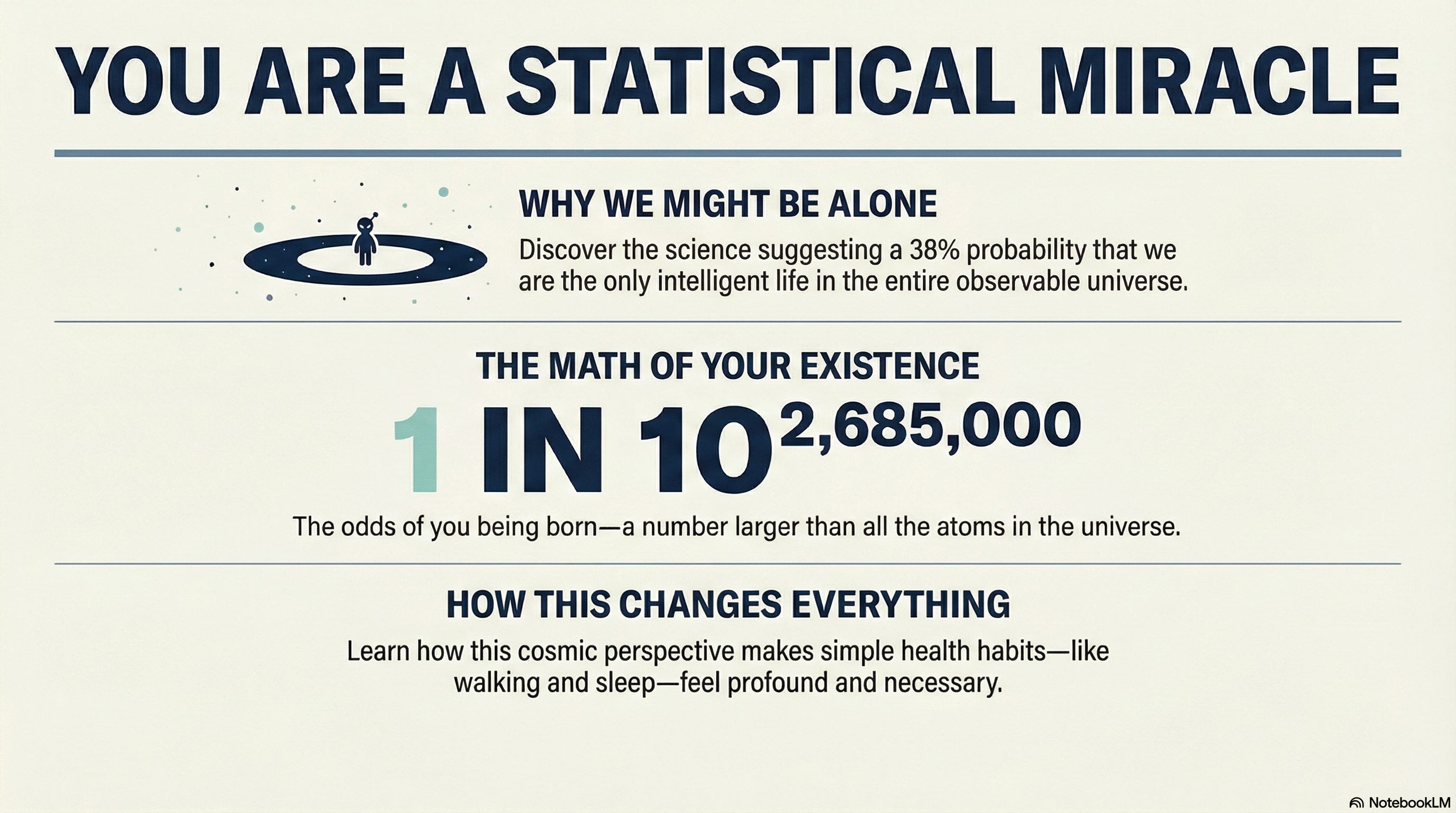
When they properly accounted for scientific uncertainty across multiple parameters, they found a 52% probability that we are alone in our entire galaxy.
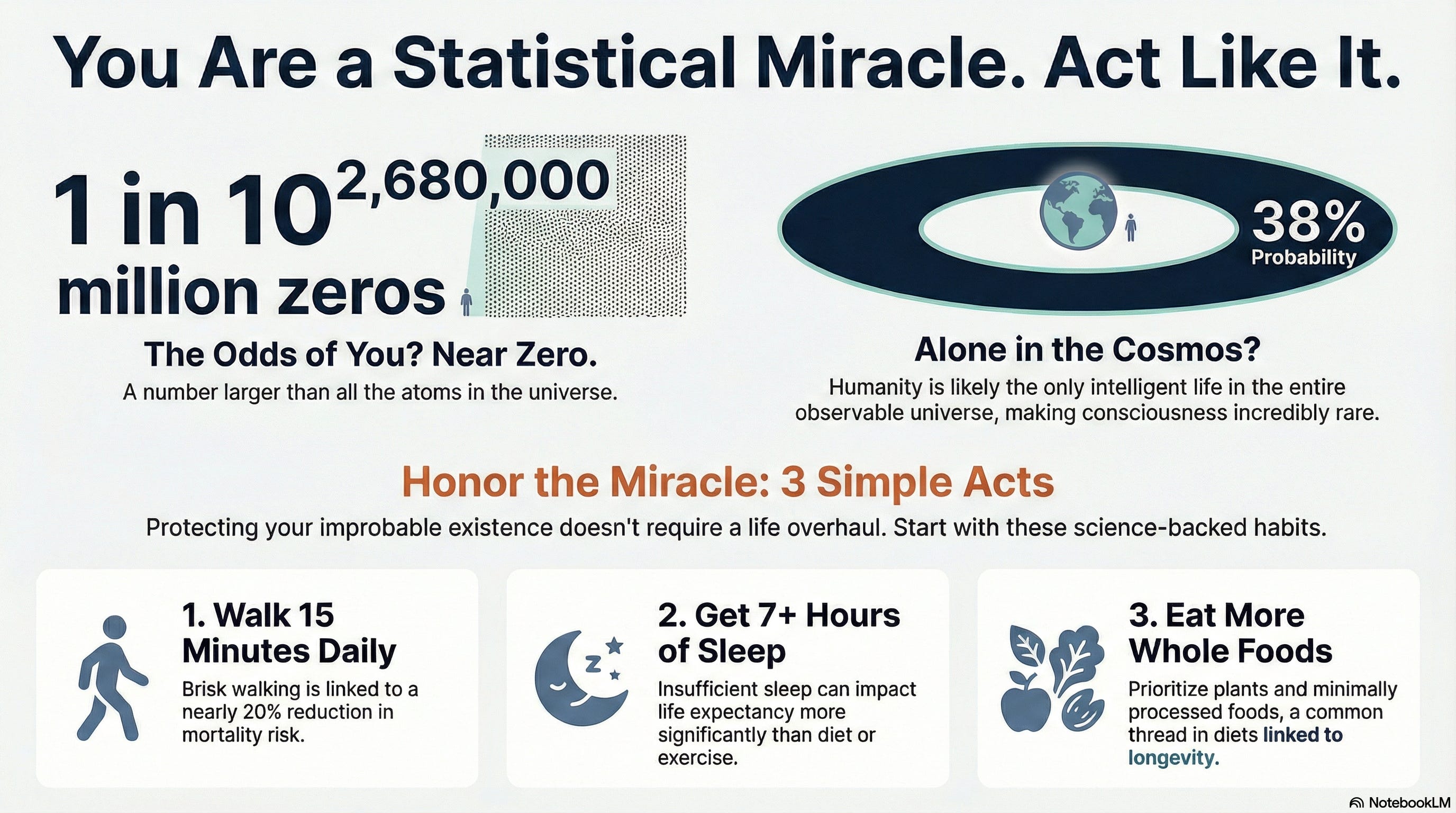
And a 38% probability that we are the only intelligent life in the observable universe.
Think about that for a moment.
With a one-in-three chance of being alone among 70 sextillion stars, humanity might be the only conscious observers in existence.
If you’re finding value in this, consider subscribing. I write weekly about the science of healthy aging, helping you navigate the research so you can make better decisions about your health. It’s free, and you can unsubscribe anytime.
Why Earth might be a one-time miracle
A 2024 study published in Scientific Reports makes the case for our cosmic loneliness even stronger. Geologists Robert Stern and Taras Gerya examined what it actually takes for intelligent life to emerge.
Their conclusion?
You need an incredibly specific set of geological conditions: both continents and oceans (not too much water, not too little), plus billions of years of active plate tectonics.
The fraction of planets that meet these requirements? Less than 0.002%.
And that’s just one factor among dozens. The conditions for complex life are so specific, so dependent on countless variables aligning perfectly, that our existence might genuinely be a singular event in cosmic history.
Now, I want to be careful here.
Science doesn’t deal in certainties.
New discoveries could change this picture entirely.
Tomorrow we might detect a signal from Proxima Centauri that rewrites everything we know.
But based on current evidence, the silence of the universe isn’t a puzzle to be solved. It’s a statement about how rare we are.
The mathematics of you
Let’s bring this closer to home. Because the improbability doesn’t stop at the species level. It gets personal.
Dr. Ali Binazir, who studied at Harvard and Cambridge, attempted to calculate the probability of any specific individual being born. The numbers are almost comically large.
Start simple. The odds of your father meeting your mother? Roughly 1 in 20,000, given how many potential partners each would have encountered. The odds of them talking, dating, and staying together long enough to have children? Maybe 1 in 2,000. Already we’re at 1 in 40 million.
Now consider biology. A fertile woman has about 100,000 viable eggs. A man produces around 4 trillion relevant sperm over his reproductive lifetime. The specific combination of sperm and egg that made you? One in 400 quadrillion.
But we’re just getting started.
For you to exist, every single one of your ancestors had to survive to reproductive age and successfully have children. Every one. Going back through 150,000 generations of human and pre-human evolution. A single death, a single infertility, a single decision to marry someone else, and you never exist.
Binazir’s final calculation? The probability of you being born as you, with your exact genetic makeup, is approximately 1 in 10 to the power of 2,685,000.
That’s a 10 followed by 2.68 million zeros.
To put that in perspective: the number of atoms in the entire observable universe is estimated at 10 to the power of 80. The probability of your existence is unfathomably smaller than one atom among all atoms in the cosmos.
“A miracle is an event so unlikely as to be almost impossible. By that definition, you are a miracle.” — Dr. Ali Binazir
What this means for how you live
So where does this leave us?
Some people might find the vastness of cosmic indifference depressing. All those empty stars, all that cold space, our tiny blue dot spinning in the void. But I see it differently.
If human life is genuinely rare (possibly unique) then each of us carries something precious beyond calculation. Not in a mystical sense. In a mathematical one. Your consciousness, your ability to experience wonder, your capacity to love and create and understand: these might be the rarest phenomena in existence.
And that changes the stakes.
Because if you’re a statistical miracle, then wasting your health feels different. Neglecting sleep becomes harder to justify. Eating poorly seems less defensible. Skipping movement makes less sense.
I’m not saying you need to become a perfectionist or stress about every lifestyle choice. That would actually work against your wellbeing. But a certain baseline respect for this improbable gift? That seems appropriate.
Three practical ways to honor the miracle
The evidence base for lifestyle medicine keeps growing stronger. Here are three science-backed starting points that require minimal effort but offer substantial returns.
Move a little more, at a reasonable pace. A 2025 study published in the American Journal of Preventive Medicine followed nearly 85,000 participants for over 16 years. The findings? Just 15 minutes of brisk walking daily was associated with a nearly 20% reduction in mortality risk. You don’t need a gym membership or elaborate workout plan. You need a pair of shoes and a willingness to walk with purpose.
Protect your sleep. A December 2025 study in Sleep Advances found something striking: insufficient sleep had a more significant impact on life expectancy than diet, physical activity, or even social isolation. The American Academy of Sleep Medicine recommends at least seven hours per night. If you’re routinely getting less, that’s probably the highest-leverage health intervention available to you.
Eat more plants, less processed food. A 2025 review in Applied Sciences analyzed multiple dietary patterns and their effects on longevity. The Mediterranean and DASH diets consistently showed reduced cardiovascular and all-cause mortality. The common thread? Whole foods, minimal processing, plenty of vegetables. You don’t need a complicated protocol. Just shift the ratio toward real food.
Individual responses to these interventions vary based on genetics, existing health conditions, and countless other factors. They’re not guarantees. But they’re reasonable bets given the evidence.
The bottom line
Look up tonight. Those stars you see are part of a cosmos that has been silent for 13.8 billion years.
No signals.
No visitors.
No evidence of anyone else out there.
And here you are.
A conscious being, reading these words, capable of wondering about your place in the universe.
The mathematical odds against your existence are so extreme they essentially round to zero.
You are not ordinary.
You are not replaceable.
You are quite literally one of the most improbable events in the history of everything.
Act accordingly.
What’s one small change you’re considering after reading this?
Drop a comment below. I read every response.
Medical Disclaimer: This article is for educational purposes only and does not constitute medical advice. Individual health needs vary considerably. Consult with a qualified healthcare professional before making significant changes to your diet, exercise, or sleep habits.
REFERENCES
Binazir, A. (2011). What are the chances of your coming into being? HuffPost. https://www.huffpost.com/entry/probability-being-born_b_877853
Liu, Y., Wen, W., Mumma, M. T., Zheng, W., & Blot, W. J. (2025). Daily walking and mortality in racially and socioeconomically diverse U.S. adults. American Journal of Preventive Medicine. https://doi.org/10.1016/j.amepre.2025.107738
McAuliffe, W. H. B., et al. (2025). Insufficient sleep and life expectancy: A population-level analysis. Sleep Advances. https://doi.org/10.1093/sleepadvances/zpaf090
Sandberg, A., Drexler, E., & Ord, T. (2018). Dissolving the Fermi Paradox. arXiv. https://doi.org/10.48550/arXiv.1806.02404
Stern, R. J., & Gerya, T. (2024). The importance of continents, oceans and plate tectonics for the evolution of complex life: Implications for finding extraterrestrial civilizations. Scientific Reports, 14, 8552. https://doi.org/10.1038/s41598-024-54700-x
Brilliant framing. The leap from Fermi Paradox to personal mortality is unexpected but works. What grabbed me most is how the brisk walking rec cuts through all the optimization noise, its almost embarassingly simple but that's exactly why most people will actually do it versus some elaborate protocol.
An amazing realisation and so thought provoking. The band Nightwish have written several songs on this topic including Perfume of the Timeless (check out the video https://www.youtube.com/watch?v=oHCaZmIzr0o which deals with how many ancestors we needed to have lived, loved and survived to be here) and also The Greatest Show on Earth. I go back to these all of the time when I need perspective!