
Where your longevity actually comes from
Modern medicine is built around crisis care. Most of the longevity work happens between visits.

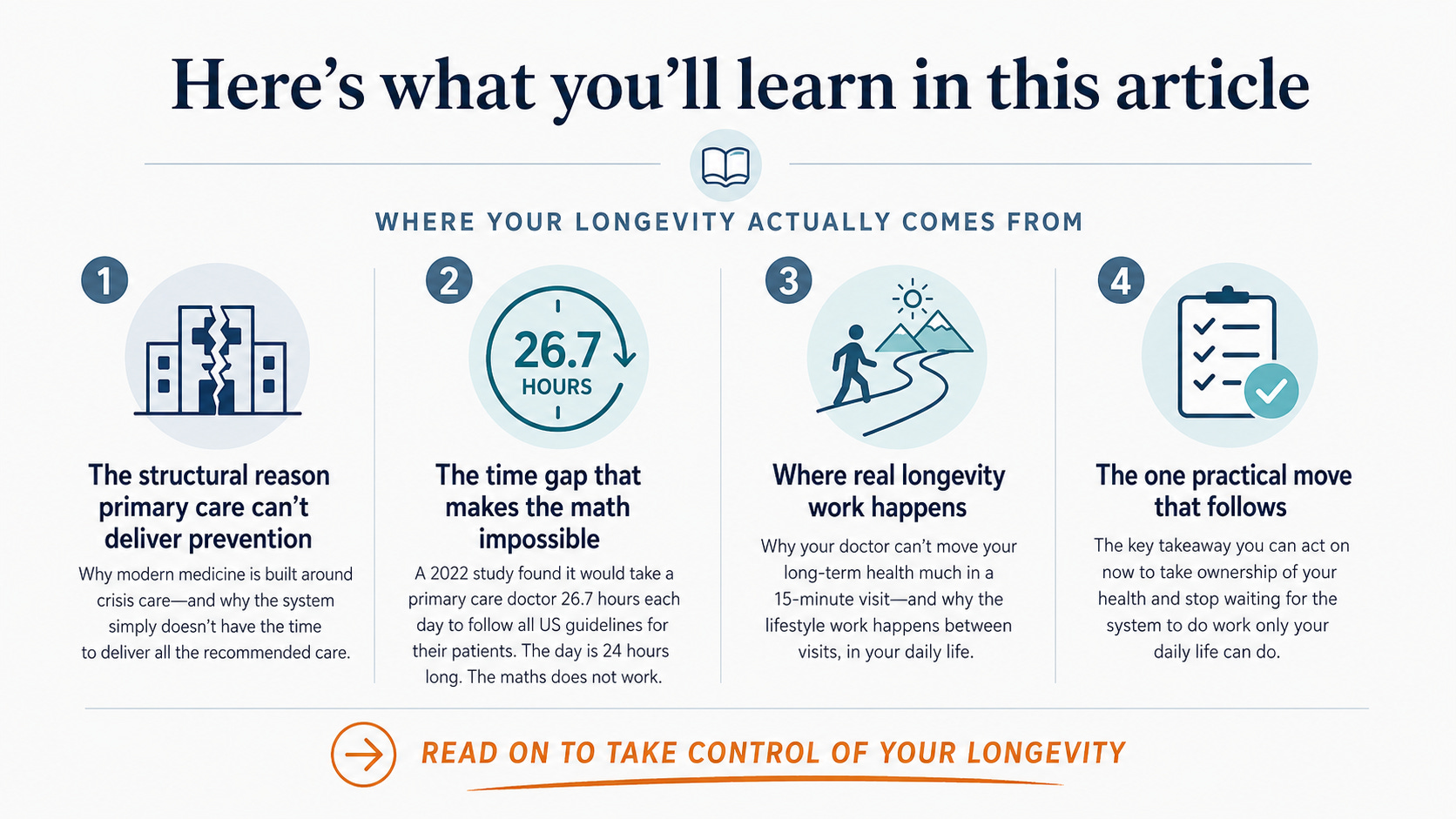
A 2022 simulation study in the Journal of General Internal Medicine worked out how long a primary care doctor would need each day to give a standard panel of patients the care that current US guidelines recommend [1].
The answer was 26.7 hours.
The day is 24 hours long.
The maths don’t math.
That gap is the structural reason your doctor cannot move your long-term health much in a 15-minute visit.
The lifestyle work happens between visits, in your daily life.
In this article, you will see the structural reason primary care struggles to deliver prevention, the size of the lifestyle effect on disease-free life-years, and the one practical move that follows.
That should help you stop waiting for the system to do work only your daily life can do.
The 26.7-hour problem
The Porter study modelled a US primary care doctor caring for a hypothetical panel of 2,500 adults [1].
The researchers built a time budget.
They added up every minute it would take to deliver every piece of preventive, chronic, and acute care that current US guidelines recommend for that panel, then totalled it.
Their answer broke down as 14.1 hours of preventive care, 7.2 hours of chronic disease management, 2.2 hours of acute care, and 3.2 hours of documentation and inbox work. Even with a team-based model that shifts most of the load to a wider care team, the doctor still needed 9.3 hours a day.
None of this is a failure of will.
Most health professionals are exhausted because they care.
They would happily spend an hour with you on sleep, food, movement, and stress if the schedule allowed it.
The 15-minute (or less) consult is the constraint everyone is working inside, doctor and patient alike.
This matters because it changes who you wait for. If the appointment cannot carry the prevention load, prevention has to come from somewhere else. The data point to a single place.
Where the decade comes from
A 2020 prospective cohort study in the BMJ followed 73,196 women and 38,366 men for up to 34 years [2]. Each person was scored on five low-risk lifestyle factors: never smoking, a body mass index between 18.5 and 24.9, at least 30 minutes a day of moderate or vigorous activity, moderate alcohol intake, and a diet-quality score in the top 40%.
At age 50, women who hit four or five of those factors lived 34.4 years free of cancer, cardiovascular disease, and type 2 diabetes, compared with 23.7 years for women who hit none. That is roughly 10.7 additional years of disease-free life. For men the gain was smaller but still large, 7.6 years (31.1 vs 23.5 years free of major chronic disease).
The Li study is observational, not a trial. People who eat well and move regularly tend to have higher incomes, better housing, and more social support, and some of what gets credited to the behaviour belongs to the conditions that made the behaviour possible. The cohort was also drawn from US nurses and health professionals, which is not the general population.
Those caveats matter. The size of the effect still does.
Five basic behaviours, sustained over decades, line up with a disease-free decade on average. The follow-up was long enough (up to 34 years) that people scoring four or five factors at baseline generally held those habits for the long haul, not for a few weeks.
The bar is low. The Harvard cohort got that gain from five ordinary actions that most adults can, in principle, do. None of them needed a gym membership, a continuous glucose monitor, or a supplement stack.
What to do this week
Three things, in order:
Pick one habit. Not five. One.
Shrink it until it survives a bad week. Ten minutes of walking after dinner. One alcohol-free night a week. A protein-forward breakfast. Lights down by 9.30pm.
Show up for screening and any medication your own doctor has already prescribed. The system catches what you cannot see for yourself. Your daily habits build the body those checks are looking at.
Think of the doctor’s visit as a checkpoint and your daily life as the trajectory.
A checkpoint can flag a problem early and adjust what is on your prescription list, but it cannot move your trajectory.
Only what you do across the other 8,760 hours of the year can do that.
The basics work.
Wishing you the best of health,
Adrian
This newsletter is free. If someone you know would find this useful, send it their way.
Medical disclaimer
This article is general health information for adults, not personalised medical advice. It is not a substitute for consultation with your own doctor. The research described here is observational, which means it shows associations but cannot prove cause and effect. Individual results vary. If you have a medical condition, are pregnant, take medication, or are considering changes to your treatment or lifestyle, talk to your own doctor first.
References
Porter J, Boyd C, Skandari MR, et al. Revisiting the Time Needed to Provide Adult Primary Care. J Gen Intern Med. 2022;38(1):147-155. DOI: 10.1007/s11606-022-07707-x. PMID: 35776372. https://doi.org/10.1007/s11606-022-07707-x
Li Y, Schoufour J, Wang DD, et al. Healthy lifestyle and life expectancy free of cancer, cardiovascular disease, and type 2 diabetes: prospective cohort study. BMJ. 2020;368:l6669. DOI: 10.1136/bmj.l6669. PMID: 31915124. https://doi.org/10.1136/bmj.l6669
"Pick one habit. Not five. One. Shrink it until it survives a bad week. Ten minutes of walking after dinner. One alcohol-free night a week. A protein-forward breakfast. Lights down by 9.30pm.
Show up for screening and any medication your own doctor has already prescribed. The system catches what you cannot see for yourself. Your daily habits build the body those checks are looking at."
This is great!!
This is eye opening information. Primary care is so over loaded and unable to keep up with the system. I love your practical advice and choosing 1 habit to start. We have to participate in our own care.